
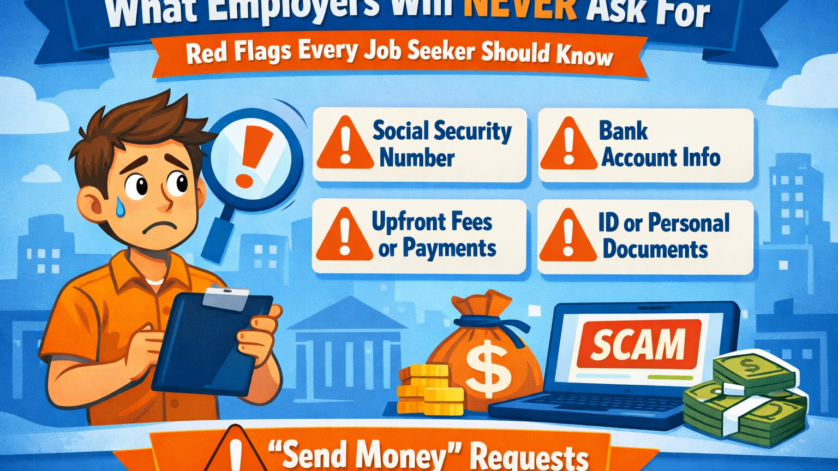
When searching for a new position, it’s important to understand what employers will never ask for during the application or hiring process. Job scams have increased dramatically in recent years, and many target applicants who may not realize when something feels “off.” Knowing these warning signs can help you avoid fraud, protect your identity, and pursue only legitimate job opportunities.
In this guide, you’ll learn the red flags, what information real employers will never request, and how to stay safe during your job search.
Why Knowing What Employers Will Never Ask For Matters
Job seekers are increasingly targeted by scammers pretending to be recruiters, HR managers, or well-known companies. These fake employers often use professional-looking emails, logos, and job descriptions to lure applicants in.
Understanding what employers will never ask for upfront helps you instantly identify when something is suspicious.
Employers Will Never Ask for Your Social Security Number During Initial Application
One of the biggest red flags is a request for your Social Security number (SSN) before a job offer is officially made.
Legitimate employers may eventually require this information for background checks or payroll after you’re hired, but they will never ask for an SSN:
- – On an initial application
– In an email
– Through a text message
– Over a messaging app
– Before verifying your identity or conducting an interview
If a recruiter claims they need your SSN “to process your application,” it’s a scam. This is a common identity-theft tactic.
Real Employers Will Never Ask for Banking Information Before You’re Hired
Another major warning sign: requests for your bank account number, routing number, or online login credentials early in the process.
A legitimate company may ask for bank details only after you’re hired—usually to set up direct deposit. However, they will never:
- – Ask for banking information during an interview
– Require access to your online banking portal
– Request screenshots of your bank account
– Ask you to “verify your identity” using financial details
If this happens, stop immediately. This is almost always an attempt at financial fraud.
Employers Will Never Ask You to Pay for a Job
A genuine employer covers all costs associated with hiring. They will never ask you to make any kind of payment.
Beware of phrases like:
- – “You need to pay for your training materials.”
– “Send money to secure your interview slot.”
– “We require a processing fee.”
– “You must purchase company equipment from us.”
Scammers often ask for payments through gift cards, cryptocurrency, prepaid debit cards, or wire transfers—methods that are nearly impossible to track.
If someone is asking you to pay to work for them, it is not a real job.
Employers Will Never Ask You to Communicate Only Through Messaging Apps
Legitimate companies typically communicate through:
- – Company email addresses
– Phone calls
– Professional video platforms like Zoom or Teams
Be cautious if a “recruiter” insists on interviewing or onboarding you only through:
- – WhatsApp
– Telegram
– Signal
– Facebook Messenger
These platforms are often used by scammers because they make it harder to trace messages.
Employers Will Never Rush You Into a Decision
Scammers thrive on pressure. They may say things like:
- – “You must accept today.”
– “Send your information in the next 30 minutes.”
– “We need this fee immediately or you lose the job.”
Real employers follow structured hiring processes and never force you into instant decisions.
How to Protect Yourself During Your Job Search
- – Research the employer’s official website.
– Look up the recruiter on LinkedIn.
– Verify email domains (avoid Gmail, Yahoo, Outlook for company communications).
– Never send sensitive information to unverified sources.
For more safety tips, see my guide on How to Spot Fake Job Postings.
Final Thoughts
Knowing what employers will never ask for is crucial to protecting your identity and financial security. If a request feels invasive, rushed, or unprofessional, it’s likely a scam. Always step back, verify the employer, and trust your instincts.
To learn more about staying safe online, you can also read this helpful resource from the Federal Trade Commission:
https://consumer.ftc.gov/articles/job-scams
And feel free to check out my related article: Common Remote Job Scams to Avoid (And How to Spot Them).