
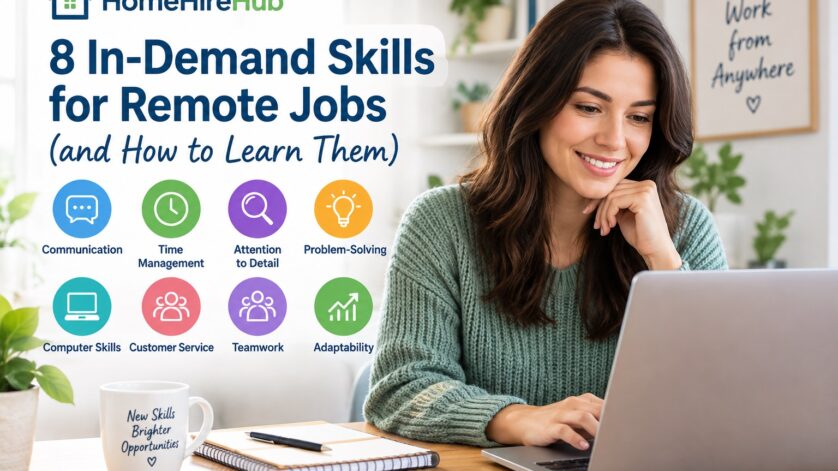
Looking for a remote job but wondering whether you have the skills employers want? You may already have more of them than you realize.
Many remote positions require more than job-specific knowledge. Employers also look for people who can communicate clearly, manage their time, solve problems, and work independently.
The good news? You don’t necessarily need years of experience or an expensive certification to start developing these skills.
Whether you’re searching for your first job, returning to the workforce, or transitioning to a remote career, understanding which skills employers value can help you prepare for applications and interviews.
In this guide, we’ll explore eight skills that can be useful when applying for remote jobs, explain why they matter, and share practical ways to strengthen them.
1. Communication
Clear communication is important in nearly every workplace, but it can be especially valuable in remote positions.
When coworkers aren’t sitting in the same office, they often rely on email, messaging platforms, video meetings, and written instructions to stay connected.
Employers may look for candidates who can:
- Write clear, professional emails and messages.
- Explain information in a way others can understand.
- Ask questions when instructions are unclear.
- Listen carefully and respond appropriately.
- Share updates about their work and progress.
How to develop this skill
Practice writing professional emails and summarizing information in your own words. If you’re comfortable helping others, consider how you explain instructions, answer questions, or resolve misunderstandings.
You can also practice writing short, clear responses to common workplace scenarios.
Remote jobs where communication is especially useful:
- Customer service representative
- Chat and email support specialist
- Virtual assistant
- Administrative assistant
- Sales representative
- Content writer
Resume tip: Instead of simply writing “good communication skills,” provide evidence when possible. For example:
Communicated with customers to answer questions, explain procedures, and resolve concerns.
Only use examples that accurately reflect your experience.
2. Time Management and Organization
Remote employees often need to manage their responsibilities without someone physically nearby to remind them what to do next.
That makes time management and organization valuable skills for many work-from-home positions.
Employers may value people who can:
- Prioritize tasks and meet deadlines.
- Keep track of assignments and appointments.
- Follow schedules and established procedures.
- Work independently when appropriate.
- Recognize when they need help or clarification.
How to develop this skill
Start with a simple task list or calendar. Practice breaking larger projects into smaller steps, setting realistic deadlines, and tracking your progress.
Free digital calendars and task-management tools can help you build these habits.
You may already have relevant experience from coordinating family schedules, managing household responsibilities, volunteering, or organizing school activities. These experiences can demonstrate transferable skills, although you should distinguish personal responsibilities from professional work experience on your resume.
Remote jobs where organization is especially useful:
- Data entry clerk
- Virtual assistant
- Administrative assistant
- Appointment scheduler
- Bookkeeping assistant
- Recruiting coordinator
Resume tip: Be specific about what you have actually done. For example, if you have professional or volunteer experience, you might describe how you maintained schedules, tracked deadlines, or organized records.
3. Attention to Detail
Small mistakes can create significant problems in jobs involving data, documents, customer information, or financial records.
Attention to detail helps employees identify errors, follow instructions, and produce accurate work.
This skill can be particularly important in entry-level positions because employers may provide procedures that employees must follow consistently.
Employers may look for candidates who can:
- Enter information accurately.
- Review documents for errors.
- Follow written instructions.
- Notice inconsistencies.
- Check their work before submitting it.
How to develop this skill
Practice reviewing documents for spelling mistakes, checking information against a source, or organizing sample spreadsheets.
If you’re interested in data entry, you can create a practice spreadsheet and enter sample information. Then review it for missing entries, duplicate records, and formatting inconsistencies.
These exercises can also help you develop examples to discuss during interviews.
Remote jobs where attention to detail is especially useful:
- Data entry clerk
- Records specialist
- Administrative assistant
- Bookkeeping assistant
- Transcriptionist
- Quality assurance support
Resume tip: Describe the tasks you’ve performed rather than relying on a vague statement. For example:
Reviewed records for missing information and corrected data-entry errors.
Use this wording only if it reflects your actual experience.
4. Problem-Solving and Critical Thinking
Employers value people who can recognize problems, evaluate information, and determine an appropriate next step.
In remote jobs, you may not always be able to ask a coworker for immediate help. Being able to investigate a problem and explain what you’ve tried can make collaboration more efficient.
Problem-solving doesn’t mean you must know every answer. It means you can approach challenges thoughtfully.
Employers may value candidates who can:
- Identify the source of a problem.
- Follow troubleshooting instructions.
- Compare possible solutions.
- Recognize when an issue needs to be escalated.
- Learn from mistakes and feedback.
How to develop this skill
Practice breaking problems into smaller parts. When something doesn’t work, identify what happened, what you expected to happen, and what you can test next.
You can also strengthen this skill through puzzles, spreadsheet exercises, basic computer troubleshooting, or free online learning activities.
If you’ve solved problems at work, school, through volunteering, or in personal projects, consider which examples demonstrate your ability to think through a challenge.
Remote jobs where problem-solving is especially useful:
- Customer service representative
- Technical support representative
- Administrative assistant
- Operations assistant
- Data entry specialist
- Research assistant
Resume tip: When possible, explain the problem you addressed and the action you took. A concrete example is more persuasive than simply listing “critical thinking” as a skill.
5. Computer Skills and Digital Literacy
Most remote jobs require some comfort using a computer and digital tools. The exact requirements depend on the position, but basic digital literacy can help you qualify for a wider range of opportunities.
You don’t necessarily need advanced technical skills to get started.
Many entry-level remote jobs ask candidates to use tools such as:
- Email and internet browsers
- Word-processing software
- Spreadsheets
- Video conferencing platforms
- Online calendars
- Customer service or record-management systems
Some positions may also require specialized software, but you can learn those tools as you gain experience.
How to develop this skill
Start by identifying the software mentioned most often in the job listings you’re interested in.
Then practice using the tools relevant to those roles. For example:
- Data entry: Practice spreadsheet formatting, sorting, and basic formulas.
- Administrative work: Practice creating documents, organizing calendars, and managing email.
- Customer service: Become comfortable navigating websites, following instructions, and entering information into forms.
- Writing: Practice using word-processing tools, editing documents, and organizing digital files.
Look for free tutorials and beginner courses before paying for training. You may not need a formal certificate for the jobs you’re targeting.
Remote jobs where computer skills are especially useful:
- Data entry clerk
- Virtual assistant
- Customer service representative
- Chat and email support specialist
- Administrative assistant
- Content writer
Resume tip: List the specific programs you know how to use. If you have basic spreadsheet skills, for example, describe them accurately rather than claiming advanced proficiency.
6. Customer Service and Interpersonal Skills
Customer service skills aren’t limited to jobs with “customer service” in the title.
The ability to listen, respond professionally, understand another person’s needs, and handle difficult situations can be valuable across many industries.
Even employees who rarely interact with customers may need to work with coworkers, supervisors, vendors, or clients.
Employers may look for people who can:
- Respond patiently and professionally.
- Listen to questions and concerns.
- Explain information clearly.
- Remain calm when conversations become difficult.
- Treat people respectfully.
- Follow established procedures when resolving issues.
How to develop this skill
Think about situations in which you’ve helped someone understand a process, answered questions, or worked through a disagreement.
You can also practice responding to common customer service scenarios, such as handling a delayed order or explaining a policy.
If you haven’t held a customer-facing job, relevant examples might come from volunteering, community activities, or other situations where you’ve helped people. Be transparent about where that experience came from.
Remote jobs where customer service skills are especially useful:
- Customer service representative
- Chat support agent
- Email support specialist
- Appointment scheduler
- Sales representative
- Client services assistant
Resume tip: Highlight actual examples of helping people, answering questions, resolving concerns, or communicating professionally.
7. Teamwork and Collaboration
Working remotely doesn’t mean working entirely alone.
Remote employees may collaborate with coworkers across different locations and time zones. They need to share information, respond to requests, and contribute to shared goals.
Employers may value people who can:
- Work cooperatively with others.
- Accept constructive feedback.
- Share updates and information.
- Respect different perspectives.
- Follow team procedures.
- Ask for help when necessary.
How to develop this skill
Think about group projects, volunteer activities, community organizations, or previous jobs where you worked with others toward a shared goal.
You can also become familiar with common collaboration tools, such as shared documents, team messaging applications, and video conferencing platforms.
The goal isn’t to know every tool. It’s to understand how people use digital tools to communicate and work together.
Remote jobs where collaboration is especially useful:
- Virtual assistant
- Administrative assistant
- Recruiting coordinator
- Marketing assistant
- Content writer
- Customer service representative
Resume tip: Instead of writing only “team player,” describe how you contributed to a group effort or supported a shared objective.
8. Adaptability and Willingness to Learn
Workplace tools, processes, and expectations change. Employers often need people who are willing to learn new systems and adjust when priorities shift.
This can be especially important for entry-level applicants who may not have experience with every tool or process a company uses.
Employers may look for candidates who can:
- Learn new procedures.
- Accept feedback and make improvements.
- Adjust to changing priorities.
- Approach unfamiliar tasks with a willingness to learn.
- Seek clarification when needed.
How to develop this skill
Choose one new tool or skill related to the remote jobs you’re pursuing and spend time learning it.
For example, you might complete a free spreadsheet tutorial, practice using a digital calendar, or take an introductory course in customer service.
Keep track of what you’ve learned and any small projects you’ve completed. These examples can help demonstrate initiative when you apply for jobs.
Remote jobs where adaptability is especially useful:
- Entry-level customer service representative
- Administrative assistant
- Data entry clerk
- Virtual assistant
- Marketing assistant
- Chat and email support specialist
Resume tip: If you’ve learned a new tool, adapted to a new process, or taken steps to develop a relevant skill, explain what you did. Evidence of learning is more meaningful than simply saying you’re a fast learner.
Which Skills Should You Focus on First?
You don’t need to master all eight skills before applying for remote jobs.
Instead, start with the requirements that appear most often in the positions you’re interested in.
Different job categories emphasize different combinations of skills.
| Remote job category | Skills worth prioritizing |
|---|---|
| Data entry | Attention to detail, computer skills, organization |
| Customer service | Communication, customer service, problem-solving |
| Administrative and virtual assistant | Organization, communication, computer skills |
| Chat and email support | Written communication, attention to detail, problem-solving |
| Writing and content | Written communication, organization, adaptability |
| Recruiting and HR support | Communication, organization, attention to detail |
| Accounting and bookkeeping | Attention to detail, organization, spreadsheet skills |
| Sales | Communication, interpersonal skills, adaptability |
| Marketing | Communication, computer skills, collaboration, adaptability |
These are general recommendations, not a ranking based on an original analysis of HomeHireHub job listings. Individual employers may prioritize different qualifications, so always read the requirements in each posting carefully.
You can explore opportunities in these fields through the HomeHireHub job categories:
- Data Entry Jobs
- Customer Service Jobs
- Administrative and Virtual Assistant Jobs
- Chat and Email Support Jobs
- Writing and Content Jobs
- Recruiting and HR Jobs
- Accounting and Bookkeeping Jobs
- Sales Jobs
- Marketing Jobs
What Does Research Say About In-Demand Job Skills?
Employment research offers useful clues about the skills employers value. However, it’s important to understand what the research measures.
For example, research covering general U.S. job advertisements can help identify skills that employers frequently request across the labor market. It does not automatically tell us which skills appear most often in remote-only job postings.
A 2025 analysis from the Federal Reserve Bank of Cleveland examined skills mentioned in U.S. job advertisements from 2021 through 2023. It identified communication and customer service among frequently requested skills. Communication appeared in 34.2% of the advertisements analyzed, while customer service appeared in 26.9%.
These figures cover the job advertisements included in that study. They should not be interpreted as percentages for remote jobs specifically.
Source: Federal Reserve Bank of Cleveland — Skills Most in Demand
Employer survey research also highlights the importance of skills beyond technical qualifications. ZipRecruiter’s 2025 employer survey discussed skills such as time management, attention to detail, critical thinking, professionalism, collaboration, and communication.
Although employer surveys and job-advertisement analyses use different methods, both offer reasons to pay attention to transferable skills when preparing for a job search.
Source: ZipRecruiter Research — Employer Survey 2025
Research on remote and in-person job advertisements within a particular occupational field has also found differences in the skills emphasized. One peer-reviewed study examining media analytics job advertisements found that remote postings placed emphasis on written communication. Because the research focused on a specific occupational area, its findings shouldn’t be generalized to every remote profession.
Source: Peer-Reviewed Research on Remote and In-Person Job Advertisements
What does this mean for your job search?
Communication, organization, accuracy, problem-solving, and digital literacy are sensible skills to develop. But there is no single skill list that guarantees a job offer.
Your best approach is to compare these general recommendations with the specific requirements in the job listings you want to pursue.
How to Show Employers You Have These Skills
Knowing which skills matter is only part of the process. You also need to show employers how you can use them.
Here are four practical ways to do that.
1. Match Your Resume to the Job Description
Read the job posting carefully and identify the skills the employer specifically requests.
If the position emphasizes written communication, accuracy, and organization, make sure your resume accurately reflects any relevant experience you have in those areas.
You don’t need to include every skill in this article. Focus on the ones that genuinely match your background and the position.
2. Use Examples Instead of Empty Claims
Statements such as “hard worker,” “team player,” and “fast learner” are common on resumes.
Whenever possible, replace generic claims with examples that show what you’ve actually done.
For instance, instead of simply listing “organization,” you could describe experience maintaining schedules, tracking records, or coordinating tasks.
If you’re applying for your first job, consider relevant school projects, volunteer activities, personal projects, or other transferable experiences. Be clear about the setting in which you developed the skill.
3. Build Experience Through Small Projects
You don’t always need a paid position to begin practicing a skill.
Depending on your goals, you could:
- Create a sample spreadsheet to practice data entry.
- Draft professional email responses to hypothetical customer questions.
- Organize a sample calendar for an imaginary business.
- Create a short writing portfolio.
- Complete a free introductory course related to your target job.
These exercises can help you develop practical skills and give you something concrete to discuss during interviews.
Just remember to label practice projects honestly. Don’t present simulated work as paid employment or experience with an actual employer.
4. Prepare for Skills-Based Interview Questions
Employers may ask questions designed to understand how you handle real situations.
Examples include:
- How do you prioritize multiple tasks?
- What would you do if you noticed an error in a record?
- How would you handle a frustrated customer?
- Tell me about a time you had to learn something new.
- How do you stay organized when working independently?
Think of examples that demonstrate your abilities. If you have limited professional experience, you can draw on relevant volunteer work, school projects, or other appropriate experiences.
Your examples don’t have to be dramatic. A straightforward explanation of how you approached a problem can be effective.
Where Can You Find Free Ways to Develop These Skills?
You may be able to strengthen several of these skills without paying for a course or certification.
Consider starting with:
- Free software tutorials: Practice the programs mentioned in the job listings you’re targeting.
- Online learning resources: Look for introductory lessons in communication, spreadsheets, customer service, or time management.
- Practice projects: Create sample documents, spreadsheets, or written responses that demonstrate your abilities.
- Volunteer opportunities: When available, volunteering can provide practical experience with communication, organization, and teamwork.
- Everyday practice: Use calendars, task lists, and digital tools to build habits that translate to remote work.
Before purchasing a course, check whether employers actually require a particular certification. Some positions require specific credentials, while others focus more on practical skills and experience.
Your goal is to develop the abilities relevant to the jobs you want—not to collect certificates simply for the sake of having them.
Ready to Find a Remote Job?
Developing in-demand skills can help you prepare for a remote job search, but you don’t have to wait until you feel completely qualified to start applying.
Begin by identifying the skills required for the positions you’re interested in. Choose one or two areas to strengthen, practice them, and look for honest ways to demonstrate your abilities on your resume.
If you’re starting your career or returning to the workforce, remember that transferable skills can be valuable. You may have developed communication, organization, problem-solving, or adaptability through experiences outside traditional employment.
The next step is finding opportunities that fit your current skills and goals.
Explore these HomeHireHub resources to continue your search:
- Entry-Level Remote Jobs: Explore remote opportunities that may suit people starting or restarting their careers.
- Remote Jobs That Require No Experience: Find opportunities that may be suitable for applicants without previous experience in the role.
- Part-Time Remote Jobs: Explore remote positions offering part-time schedules.
- HomeHireHub Resources: Find helpful job-search resources and downloadable tools.
You don’t need to have every skill mastered before taking the next step. Start where you are, keep learning, and focus on opportunities that match your abilities.